Posted by Jack Lim
Filed in Arts & Culture 2 views
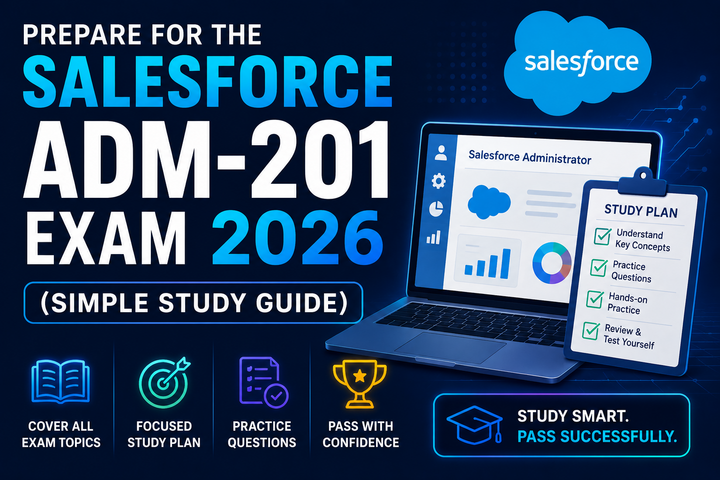
The Salesforce ADM-201 exam remains a useful starting point for people who want to build practical Salesforce skills. The current official name is Salesforce Certified Platform Administrator, but many learners still use the older ADM-201 name when searching for study help. The exam checks whether you understand common platform tasks, user needs, business processes, data handling, and basic automation.
You do not need to learn advanced coding for this exam. However, you should know how Salesforce features work in real situations. A strong study plan should combine reading, hands-on practice, short revision sessions, and topic-based questions.
Before studying individual features, understand what an administrator does. A Salesforce administrator helps users work efficiently inside the platform. This may include creating users, setting permissions, managing records, building reports, adjusting page layouts, and improving routine tasks with automation.
The exam often uses business situations instead of simple definitions. For example, a question may ask how to give a sales team access to selected records without exposing private data. Another question may ask which tool should be used to automate an approval or update.
This means memorizing terms is not enough. You should learn why a feature exists and when it is useful.
The current exam outline covers eight areas. Some topics carry more weight, so they deserve more study time.
| Exam area | Weight | What to review |
|---|---|---|
| Configuration and setup | 15% | Users, company settings, security, access |
| Object Manager and Lightning App Builder | 15% | Objects, fields, layouts, record types |
| Sales and marketing applications | 10% | Leads, opportunities, campaigns |
| Service and support applications | 10% | Cases, queues, support processes |
| Productivity and collaboration | 10% | Activities, Chatter, mobile tools |
| Data and analytics management | 17% | Imports, exports, reports, dashboards |
| Automation | 15% | Flow, approvals, business rules |
| Agentforce | 8% | Basic use, administration, and platform context |
The table gives you a clear order. Data and analytics management has the highest weight. Configuration, objects, and automation also need close attention. Agentforce is a newer part of the outline, so do not skip it.
Reading helps, but hands-on work makes the ideas easier to remember. Create a Trailhead Playground or another safe practice org. Use it to explore the Setup area and complete small tasks.
Start by creating a custom object. Add fields, adjust a page layout, and make a simple record type. Next, create sample users and compare profiles, permission sets, roles, and sharing settings. Then import test records and build a report.
You should also create a basic flow. Keep it simple at first. For example, make a flow that updates a field when a condition is met. This helps you understand automation choices without making the process confusing.
Hands-on work is important because similar tools may appear in the same question. Real practice, combined with Salesforce ADM-201 practice questions, helps you compare available options and identify the best answer more confidently.
A simple four-week plan works well for many learners. Adjust the pace if you are completely new to Salesforce.
During the first week, focus on setup, users, security, objects, fields, and layouts. In the second week, study sales, marketing, service, productivity, and collaboration features. Use the third week for data management, reports, dashboards, automation, and Agentforce basics. Reserve the final week for revision and timed practice.
Try to study in short daily sessions instead of leaving everything for the weekend. A 45-minute session with a clear goal is often more useful than several hours of random reading.
Keep a small notebook or digital file for mistakes. Write down the feature you misunderstood, the correct idea, and one short example. Review this file before every practice session.
Read → Cisco Certification Updates 2026: New Exam Topics and Career Paths Explained
Start with official Trailhead learning paths because they are aligned with the current exam topics. Salesforce provides certification prep modules with scenarios, flashcards, and links to related learning material. These resources help you understand the platform in a structured way.
After covering the official content, use additional practice material to test your understanding. Cert Empire can be used as one supplementary option for learners who want more topic-based revision. Practice questions should help you identify weak areas, not replace actual learning.
Avoid trying to memorize copied answers. The exam is more manageable when you understand the platform logic and can apply it to different business situations.
Read every question slowly. Look for the main business goal, the user type, the data involved, and any security limits. Remove options that solve only part of the problem.
Some questions include more than one reasonable answer. In those cases, choose the option that follows standard Salesforce features and requires the least unnecessary work. Do not add complex solutions when a simpler platform tool can meet the need.
When reviewing wrong answers, do not only check the correct choice. Study why your selected option was weaker. This habit improves decision-making and prevents repeated mistakes.
Security settings often confuse new learners. Make sure you understand the difference between profiles, permission sets, roles, sharing rules, and organization-wide defaults.
Data tools also need careful study. Learn when to use imports, exports, duplicate controls, reports, and dashboards. For automation, focus on the purpose of Flow and approval processes. For Agentforce, review the basic concepts included in the official preparation material.
Your final review should focus on weak areas instead of repeating the topics you already know well.
A compact visual guide has been published on Cert Empire’s Instagram.
Many learners still search for ADM-201, but Salesforce currently presents the credential as Salesforce Certified Platform Administrator. Use the latest official exam guide before planning your preparation carefully.
Most beginners benefit from several weeks of regular study. The right timeline depends on your platform experience, daily schedule, hands-on practice, and comfort with business scenarios during revision.
Advanced coding is not required for the platform administrator exam. You should understand configuration tools, data handling, security settings, reporting, automation choices, and practical business requirements clearly enough.
Hands-on practice shows how Salesforce features connect in real tasks. It helps you compare similar tools, understand settings, solve scenario-based questions, and remember important concepts more clearly during revision.
Yes. Agentforce now appears in the official platform administrator exam outline. Review its basic purpose, administration context, and relationship with Salesforce platform features during your preparation sessions carefully.
Up next: Top 10 Highest Paying IT Certifications in 2026 to Boost Your IT Career Fast
